

The pneumatic triple eccentric butterfly valve stands at the forefront of high-performance flow control solutions, distinguished by its innovative design that addresses the most challenging requirements in industrial processes. Combining advanced engineering with robust materials, this valve excels in applications demanding tight sealing, high pressure tolerance, and reliable operation across extreme conditions.
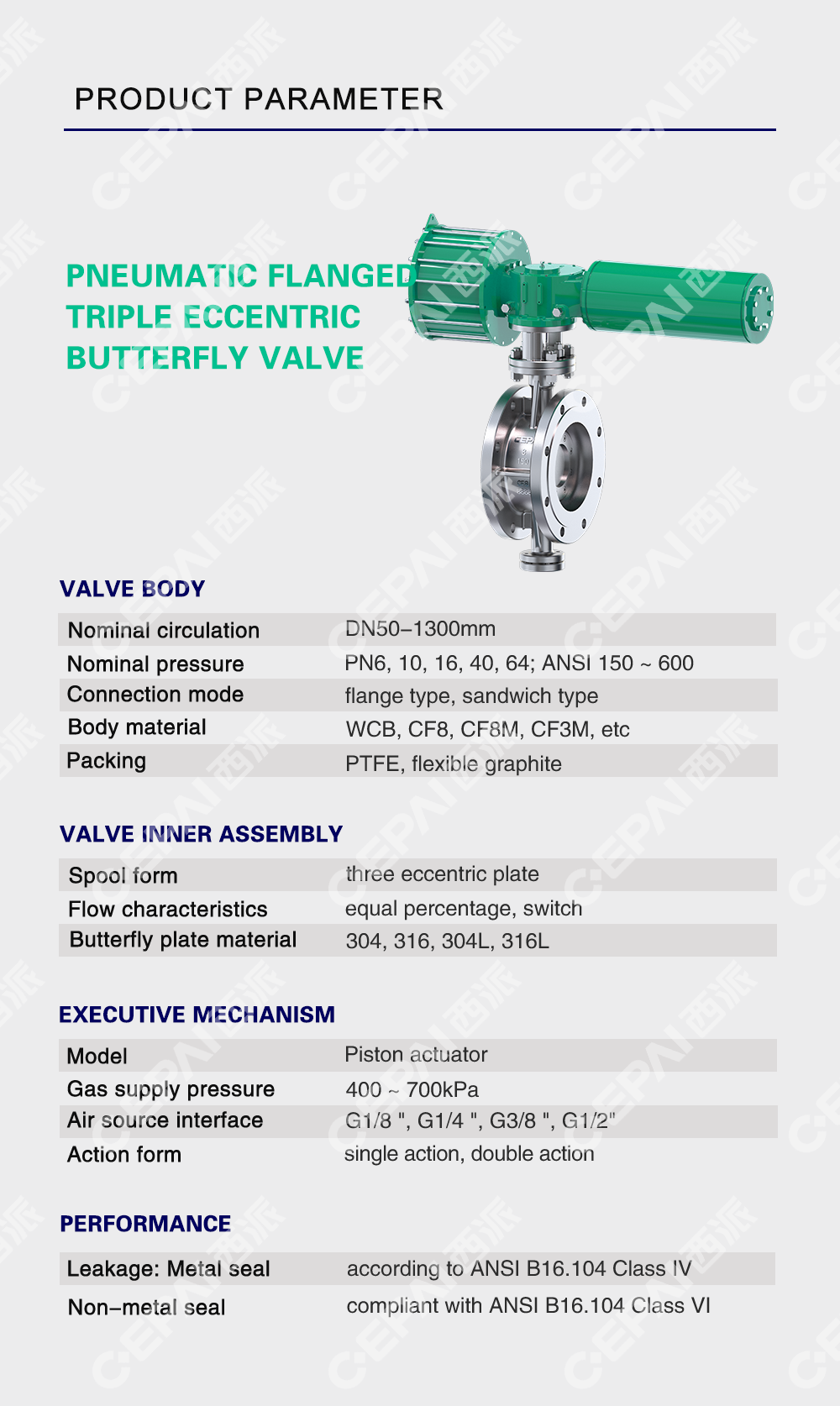
1. Design Foundations: The Triple Eccentric Advantage
The valve’s defining feature is its triple eccentric geometry, a design that eliminates friction and enhances sealing through three key offsets:
- First Eccentric: Offset between the stem and the disc’s center, reducing actuation torque.
- Second Eccentric: Offset between the stem and the seat’s centerline, creating a mechanical wedge effect for sealing.
- Third Eccentric: Tapered seat design (conical offset) that ensures the disc contacts the seat at an angle, forming a bubble-tight seal without relying on fluid pressure.
Key Components:
- Disc: Constructed from stainless steel, alloy, or tungsten carbide-coated materials for wear resistance.
- Seat: Metal-to-metal (hard seal) for high-temperature/pressure applications or PTFE-lined (soft seal) for chemical compatibility.
- Pneumatic Actuator: Double-acting (air-driven open/close) or single-acting (spring-return for fail-safe closure in air loss).
- Body: Made from carbon steel, stainless steel, or exotic alloys (e.g., Hastelloy) to withstand corrosion and harsh media.
2. Operational Mechanics
- Actuation: Compressed air powers the pneumatic actuator, rotating the stem and disc through a 90° motion.
- Sealing Principle: As the disc closes, the triple eccentric design delays contact with the seat until the final stage of rotation, minimizing wear. The tapered seat wedges the disc to create a seal with high stress, ensuring zero leakage even in high-pressure systems.
- Flow Regulation: The disc’s position precisely controls flow, with a fully open configuration enabling low pressure drop and a closed position achieving bubble-tight shut-off (ISO 15848-1 Class A).